Global - English

Lighting the Modern Stadium

What today's lighting design consultants need in order to design for tomorrow


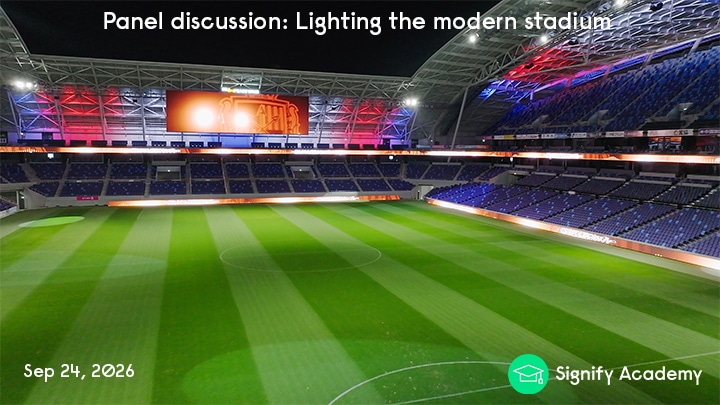
Watch this panel discussion with sports lighting experts to discover how sports venue design is evolving to meet new demands around performance, sustainability, flexibility, and user experience. Gain expert insights into modern lighting design priorities, common project challenges, and the latest connected lighting technologies shaping the future of sports facilities. Learn how to navigate changing requirements and make informed decisions that support long-term venue success.

AIA logo
CPD UK logo
Lighting the modern stadium

View the recording


Click on the image above to watch the recording on YouTube


Do you need a certificate?

Login here to view the recording and take the assessment to obtain your certificate.

Remaining questions answered

Key topics and learnings


Sports venue lighting has become about far more than achieving compliance. Today's facilities must support world-class athletic performance, evolving broadcast requirements, operational flexibility, sustainability goals, and memorable spectator experiences.


In this panel discussion, the sports lighting experts will share their perspectives on the changing demands of sports venue design. Attendees will gain practical insights into specification priorities, common project challenges, and the role of connected technologies in shaping the future of sports infrastructure.

Learning objectives:


  1. Understand how modern sports venue requirements are influencing lighting design and specification decisions.
  2. Recognize common specification challenges and best practices for balancing performance, flexibility, and sustainability.
  3. Explore how connected technologies can support both lighting performance and operational efficiency.
  4. Evaluate considerations for future-proofing sports facilities against evolving standards and user expectations.

Our panel

Moderator
Ilya

Ilya Lynov

International Key Account Manager,

Signify

Mike
Mike Simpson

Global Application Lead,

Signify

Minni Dolstra

Minne Dolstra

Director of Thialf,

Ice Skating Venue, Netherlands

Xavier

Xavier Fulbright 

Senior Associate | Technical Director

ME Engineers


With 48 years in the lighting industry, Mike began with a degree in Electrical and Electronic Engineering from South Bank University, specialising in lighting, before joining Philips Lighting in a variety of technical and design roles. His projects have included the illumination of Tower Bridge, St Paul’s Cathedral, and Blackpool’s Pepsi-Max roller coaster.


He served as President of the Society of Light and Lighting, CIBSE, and the Institution of Lighting Engineers, and later became Master Lightmonger and a Fellow of the Royal Academy of Engineering. My work has included developing international lighting standards, presenting at global conferences, and promoting sustainable building design.


A seasoned business leader with 15+ years of experience specialising in scaling B2B revenue through complex consultative sales and data-driven GTM strategies. My core expertise lies in identifying new market opportunities, architecting strategic partnerships, and leading cross-functional teams to execute growth initiatives that deliver exceptional customer value and a significant competitive edge.


Xavier leads ME Engineers' UK lighting design department working primarily in sports, leisure and entertainment venues throughout the world. He has worked on prestigious projects such as Suo Fujimoto's Serpentine Gallery Pavilion 2013, Aviva Stadium, IBM's client forum in London, Harrods'​ Cosmetics Hall and Bridal Room, MSN's Headquarters in London, and many more. His lighting design for Addleshaw Goddard's London office earned a UK Lighting Award for the 'Best Workplace' category in 2009 and was a judge for the UK Lighting Awards 2014.

Minne is an experienced executive, non-executive director, and entrepreneur with a passion for complex issues at the intersection of public-private partnerships in the sports, health, well-being, and care sectors.

Question and Answers


Question 1. What's the CCT of the Lighting maintained?

Answer: For Stadium lighting the target is between 5000K and 6000K. This is so the broadcasters don’t see a big difference in the transition between daylight and artificial lighting. 


Question 2. What is the most attractive market looking up for the upcoming 3 years:  US, Europe, Middle East or China?

Answer. The market follows the competitions so there is currently a lot of activity in the Middle East. In Europe its more upgrading existing stadia with a growing interest in fan experience.


Question 3. What is a typical design cycle life using LEDs compared with 'old days' with HMI etc?

Answer. A typical lifetime of an HMI installation would be 6000k to 50% failures. With LED’s life is defined by loss of light which can be 10% loss at 100,000h. With LED’s you also have to take into account ambient temperature as this affects light output. Over the last 10 years efficiency of LED’s has increased significantly so replacing an early LED installation could be viable on grounds of energy saving.


Question 4. I  am often faced against ecology, where ILP BCT (Bat Conservation Trust) guidance 08/23 stipulates 2700K, there are very few 2700k sports floodlight and are not commercially available, i know sports guidance says 4000k plus (why?),  the argument is colour appearance, but if CRI is is 80+, i struggle with this argument.

Answer. This is quite a big topic at the moment, but for Stadia the range is 5000K – 6000K for broadcast. The discussion is around Club/Recreational. The argument is that the lighting is there for Atheletes who prefer the cooler (4000K) for performance and if it wasn’t for the Athelete there wouldn’t be any lighting. The following is part of the proposed text for EN12193:

To minimise the ecological effect of outdoor sports lighting the following should be considered:

1.      Select the most suitable lighting class for the level of play.

2.      Ensure light is controlled so it only illuminates the area of play

3.      Use lighting controls to dim lighting in between playing sessions

4.      Choose the right spectral output to minimise the effect on animals and plants


Light Source Spectrum

It is known that the spectral composition of the light source can impact animals and plants, although the effect is not known for all species. It is therefore difficult to have one solution that covers all possibilities. For species affected by the blue end of the spectrum, just selecting the colour temperature may not give the level of control required. LED sources have a strong blue peak independent of Colour Temperature.

For general areas the percentage output in the region of 380nm-480nm should be equal of less than 19% of the total light output. This generally will be found with light sources where the Colour Temperature is =< 4000K

For protected areas the percentage of light in the region of 380nm-480nm should be equal or less than 9% of the total light output. This generally will be found with light sources where the Colour Temperature is =< 3000K

We try to take the focus off colour temperature and use actual spectral output as its possible to “play” with the spectrum to have a cooler appearance without a high blue content.

The Signify Clearflood is available from 2700K – 5700K

Related material

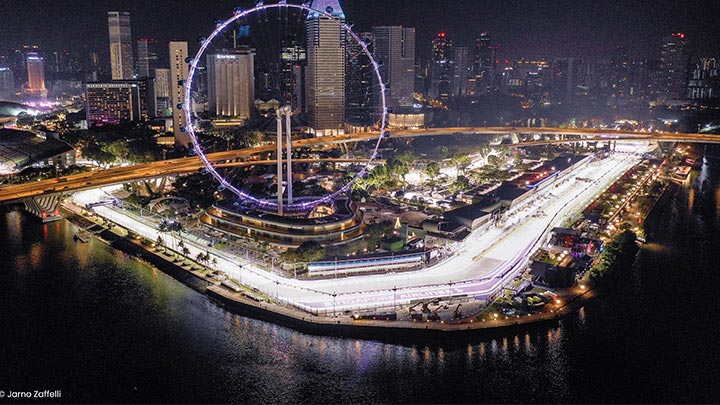
  • Motorsport Night racing

    Motorsport Night racing

    Watch this webinar to learn to use a proper Lighting Solution which is mandatory for a successful event.

  • Contact us

    Contact us

    Please let us know if you want to receive more information about this webinar topic.

  • Empowering venues to offer an unbeatable experience

    Empowering venues to offer an unbeatable experience

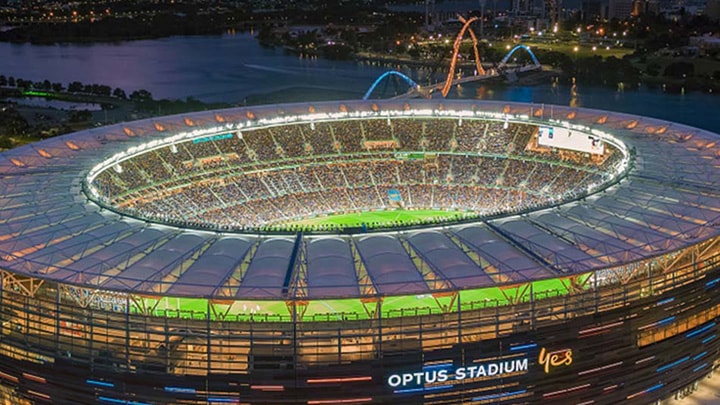
    Watch this webinar to explore how innovative lighting solutions can enhance experiences and engagement in professional sports, entertainment, and multipurpose venues.