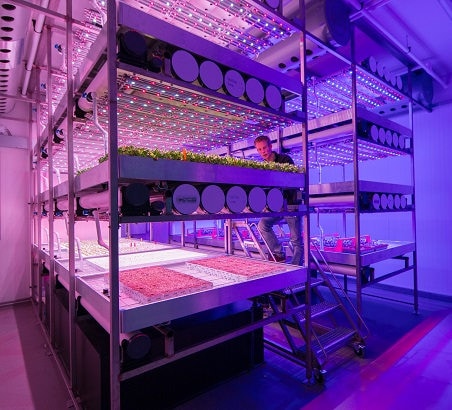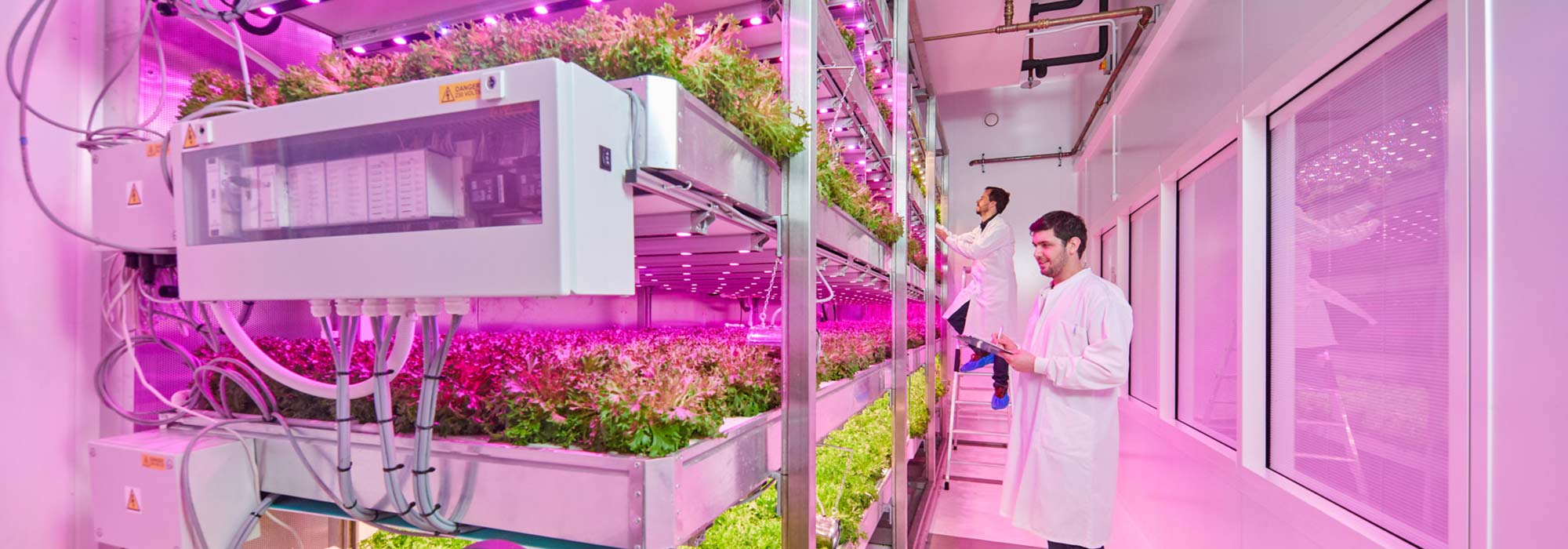
Two professionals working in their vertical farm

The role of sensors and data collection in a succesful vertical farm

The role of sensors and data collection in a successful vertical farm

It’s widely recognized that vertical farming has many advantages over traditional crop-growing methods. Simply put, despite relatively high setup and operational costs, the production per unit of growth area in vertical farms easily exceeds that in the most advanced greenhouses. But to consistently hit this level of production, you need to ensure growth conditions are continuously at their best. This is where sensors and data play a pivotal role, and why they’re ready to transform the future of vertical farming.


What data do you need to capture?

To use sensors and data effectively, you first need to know what kind of data is valuable and why. The most important values to measure are the following conditions for growth:


  • Climate (characterized by a combination of air temperature, humidity levels, CO2 levels and air speed)
  • Plant temperature
  • The nutrient composition of the irrigation water
  • The light level and spectrum (as perceived by the plants)
  • Plant morphology, deficiencies and growth (phenotyping)
     

These conditions are significant for different reasons. The difference between plant temperature and air temperature, for example, can tell us whether the leaves’ stomata are open. If they aren’t, the plant cannot absorb CO2 and convert it into biomass. Likewise, we can continually measure the pH (acidity) and EC (electrical conductivity) of the irrigation water to ensure optimal plant growth.


You might be surprised to see that we measure the light level and spectrum as perceived by the plants, presuming that we can deduce this already from the type and number of LED lighting modules installed. However, our research has found that the plants’ perceived light level can deviate up to as high as a factor of two from the light level installed depending on the optical properties of the materials used between and above the plants. This value largely depends on the degree to which the plants cover the growth area, and with such a high potential deviation rate, is one we need to measure and track to ensure optimal growth conditions.


The value of monitoring every stage of the growth process

Sensors enable us to monitor these growth conditions, recognize anomalies and identify problems as early as possible. By detecting problems at an early stage, we can respond pro-actively instead of reactively. This holds especially true for system-related problems – such as the temperature deviating from an intended setpoint – which can be rectified almost immediately.


In addition to measuring growth conditions, measuring growth results also provides valuable data – using parameters such as plant size, height, weight and color. We can use cameras to capture images of the plants in the growth layer, for example, following growth development over time and gauging whether growth meets expectations or not by comparing it to data captured in previous growth cycles under similar conditions. Like sensors, cameras can also help to prevent problems early by enabling the detection of early-stage growth deficiencies (such as tip-burn) and diseases.


How our sensor and data platform can help

Our sensor platform allows us to measure the conditions most important for plant growth. These conditions include climate parameters and irrigation parameters (including water supplied/drained in addition to pH and EC). At the GrowWise Center in Eindhoven’s High Tech Campus (HTC), we collect about 1,600 unique setpoint and sensor readings every ten minutes from our eight climate cells – valuable ongoing research that helps us to continuously build on our knowledge base and improve the solutions we can offer.


The sensors can be placed anywhere within a growth layer and wirelessly communicate the data they gather to the system backend. Cloud applications then retrieve this data and visualize the information that is most relevant and useful to plant specialists and growers. The sensor platform has been developed as  part of Horizon 2020 Internet of Food (H2020 IoF), a European Union (EU) innovation program.

Close-up of a man working in a vertical farm

The future of vertical farming

The benefits of modern sensor technology and data science are already manifold, but technological advancements in areas such as AI promise to be truly revolutionary. Signify is currently researching AI-based algorithms that can train models to couple realized growth conditions with realized growth results, for example, in a process known as ‘supervised learning’. This will ultimately enable us to predict the precise growth conditions to achieve optimal growth – and meet the most specific grower needs. AI techniques like machine learning can also be used to analyse images of plants’ growth to immediately detect any unexpected deviations or growth deficiencies.


Right now, our sensor and data platform combined with cloud applications adds considerable value for our plant specialists and customers – from monitoring the growth process and detecting problems as early as possible to accelerating the development of new optimized growth recipes. It’s clear that sensors and the data they capture play a pivotal role in the continuing evolution of vertical farms. Signify and our customers will not just be a part of this revolution – we will drive it.

How can lighting help me manage energy price volatility more intelligently?

Energy prices are rising, grid frequency imbalances are becoming more common, and price volatility is increasing—not only in North-West Europe, but in more and more markets around the world. For growers, this creates both risk and opportunity. On the one hand, it can mean higher costs and less predictability. On the other, it opens the door to new revenue opportunities and smarter cost savings. What it requires is an intelligent lighting system. With GrowWise smart energy, greenhouse LED lighting will become a smart, flexible energy asset—using the plant as a battery. It helps you plan ahead with an optimized lighting strategy for the next day, based on expected energy prices, crop targets, plant models, and system performance. And it helps you steer during the day itself, adjusting Intelligently and in real-time to changing conditions and market signals while staying aligned with your crop strategy.


How do I take the next step toward intelligent lighting?

The next step is to connect your controllable LED lighting to a Philips GrowWise control system and add intelligent apps to optimize performance automatically. This lets you improve results step by step without adding complexity. Instead of gathering data manually or mastering every variable, you get integrated insights and control so you can focus on your crop and business. Ultimately, the future of lighting is not about doing more yourself, but about having intelligence in your system working for you every day.

Picture of Dr. Marcel Krijn

About the author

Dr. Marcel Krijn is a principal research scientist at Signify and has over ten years of experience in horticulture. His primary interest is the advancement of vertical farming as a mainstream method of food production that is both energy-efficient and commercially beneficial for Signify’s customers. His research efforts also focus on the development of new options for data-driven growth management. 

Discover other articles

Follow us on a new journey combining floriculture and vertical farming

Plant specialist shares first results from flower trials conducted at BrightBox, a climate-controlled vertical farm test facility.

How LED intercanopy lighting boosts high-radiation greenhouse yields

LED intercanopy lighting enhances greenhouse yields by improving light distribution, supporting uniform growth and delivering higher crop quality year‑round.

LED inrush current and the financial impact on lighting design

It’s critical to be able to receive the proper specifications on inrush current and other key technical factors, or the project risks unplanned costs.

5 Things to check when comparing LED grow lights

The key parameters to check when comparing lighting designs for LED grow lights from different manufacturers. So your LED lighting investment delivers the full performance you paid for.

Where to buy

Our LED grow lights are sold through a global network of certified partners.

Newsletter

Stay up-to-date with the latest learnings and insights from your peers.

Starting a project?

What are the best LED grow lights for your situation? We are here to help you.