As a grower, you invest in supplemental LED grow lights because they power the yield and quality of your crops. In fact, the rule of thumb is that 1% light output equals 1% crop yield. So, it’s vital that your LED lighting investment delivers the full performance you paid for.
The performance is determined by the light intensity and light uniformity of the LED grow lights you use. If the light intensity produced by the grow lights installed is lower than what you expected from the design, there will be less yield. If the uniformity is inconsistent, individual plants will grow and develop at different rates and there will be uneven production in your greenhouse.
Before you start
When you compare different lighting designs, make sure to compare apples with apples. This means taking 3 things into account:
- Verify the credibility of the performance claims that manufacturers make.
- Make sure that DIALux calculation software is used for the lighting design. This calculation software is provided by an independent company and commonly used in the horticulture market.
- Check which input parameters have been used for each lighting design. It is easy to tweak the input parameters and give the impression of more positive light level and uniformity within the lighting design. So which parameters are crucial?
The most important input parameters to check are:
- Has the right product been specified? Check if the exact product that you have selected for your project has been used in the lighting design, with the right light output (PPF in µmol/s) and spectrum (blue/red/white/far red/…).
- Have your specific design values been used, like the average light level at your crop (PPFD in µmol/m2/s) and the overall light uniformity?
- What are the standard settings? The height of the grow light and crop (free height), reflection factors, and the size and position of the area that is used in the uniformity calculation all have an impact on the average light level and overall uniformity achieved.
#1 Check the free height
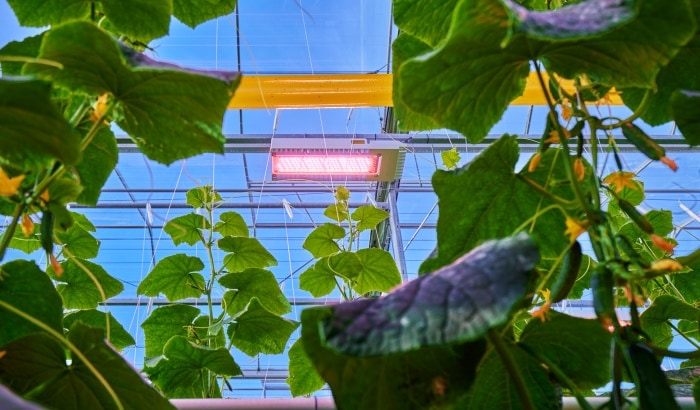
The first input parameter to check is the free height that specifies the distance between the LED module and the head of the crop. The free height can seriously impact the overall uniformity value. For high-wire tomato crops that have a limited free height of 1.50 to 2.50 m, for example, it can be a challenge to achieve a good overall uniformity value. Using an optimistic free height or calculating uniformity at floor level as if there is no crop, will positively impact the overall uniformity value.
The free height is calculated by measuring the distance between the eventual top of the crop and the mounting height of the LED grow light.