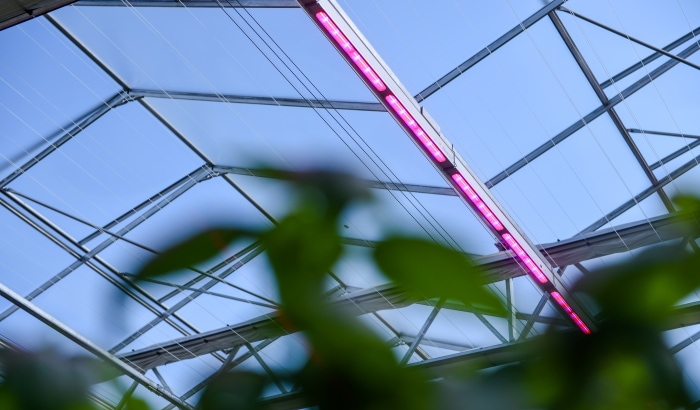
The GrowWise Control System lets you adjust the light intensity to the exact needs of your crop. When integrated with your climate computer, you can link to a daylight sensor and steer the DLI for your plants in a fully integrated way. You have full control over dimming and the amount of light, and insights and improvements here can make a big difference in your bottom line. You can address fluctuating energy prices by dimming your lights when prices are high and setting the lights to 100% when prices are down. You light your crop in a uniform way, manage your DLI and sell the produced electricity from your CHP back to the grid at the time of your choice.
Patented Coded Mains technology for uniform crop growth
The brains behind all this is the patented Philips Coded Mains technology. This robust system transmits a signal to each of the grow lights in your greenhouse to dim to the same light intensity. The signal is sent via the power cable and transports a command on the waves of the voltage. This eliminates the need for additional control cables that add costs and hassle during the system installation. The lights have an integrated sensor that reads the signal or command and reacts to your requested dim setting.
Why does the Coded Mains technology use a power cable for signal transport? The alternative is a wireless control using technology such as WIFI or Bluetooth. But there are many things in your greenhouse that can block or interfere with the wireless signal, such as: plants, water from irrigation and steel from the construction. This could cause different levels of dimming for different grow lights throughout the greenhouse, resulting in non-uniform crop growth or unexpected surprises in your energy usage. That is why, at this time, we have chosen for the solution via Coded Mains, as all the grow lights in the system need to receive the same, strong signal in order to function properly. The robustness of the Coded Mains system gives you peace of mind knowing that all lights in your greenhouse are dimmed to the same level and your crop is growing in a uniform way. That’s why Signify engineers decided to use a wired signal that is more robust in your greenhouse environment.
Dimming is better than turning off some lights
Modern growers can adjust their climate settings with great precision to achieve high yields, good quality products and produce sustainably with optimum use of resources. This also applies to adjusting artificial light. There are many reasons to adjust the light level in a greenhouse. The plants need less light at certain stages of the crop growth or at certain times of day. Young plants could have a lower tolerance to light than crops ready for harvest. On a summer day, the need for light might be lower than during a winter day.
For many growers, a checkerboard lighting setup is common practice. In this setup, growers simply turn off a number of lights to adjust the light levels. This reduces the amount of light but also negatively affects light uniformity.
That’s why dimming is better. Dimming maintains the right uniformity. And an additional advantage: the lights become even more efficient. When dimming to 50%, the efficacy of a lighting module can increase by 8%, from 3.7 to 4.0 µmol/J (depending on the product type). This not only increases the sustainability of your greenhouse operation. With today’s energy prices the savings can add up quickly and be substantial.
The power of dimming with Signify
With Signify dimming technology and the Philips GrowWise Control System you have a powerful new way to manage your crop growth and energy prices.
LED lights can be dimmed via your climate computer, so you have all your settings in one place. The Coded Mains technology sends a robust signal to the lights via the power cables, so you don’t spend extra money on extra cables. And all fixtures dim to the same level to ensure a uniform light blanket for your crop.
In short, LED lighting provides higher year-round crop growth, higher product quality and improved predictability. That can help your business results to shine a little bit brighter.
Learn more about how our horticultural LED lighting can benefit growers around the world and visit our webpages.