
UV-C disinfection devices
Discover Philips’ complete selection of environmentally-friendly UV-C disinfection devices, suitable for a wide range of applications. Filter the air with our wall and ceiling-mounted UV-C disinfection systems, and deactivate viruses and germs on items with our UV-C disinfection chambers.

FAQs
Philips UV-C air disinfection devices use germicidal ultraviolet-C radiation — typically at a wavelength of around 254 nm — to inactivate airborne microorganisms including bacteria and viruses. Air circulates naturally or through convection into the UV-C irradiation zone inside the device, where pathogens are exposed to a lethal UV dose. The treated air is then returned to the occupied space, reducing the microbial load over time.
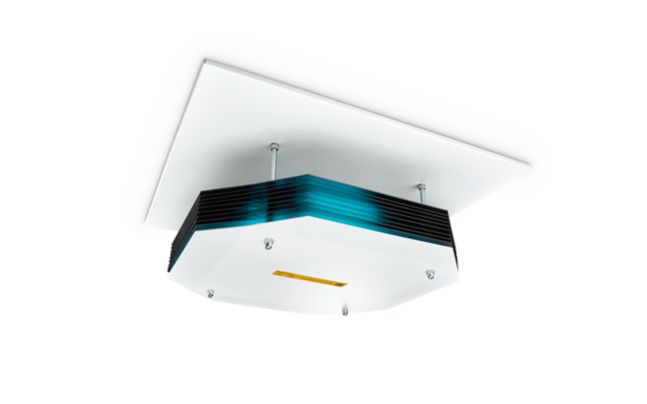
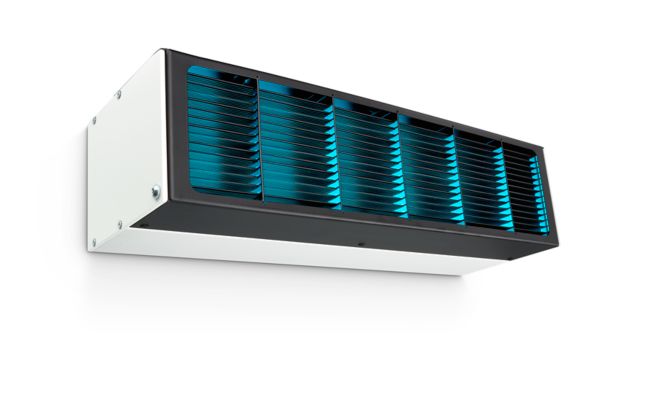
The page lists three families covering two mounting formats: UV-C disinfection upper air ceiling mounted for installation directly onto or into the ceiling plane, and UV-C disinfection upper air wall mounted (including the dedicated WM family) for positioning high on a wall. The choice depends on room geometry, ceiling height, and the airflow pattern required to ensure effective upper-air coverage.
Upper-air UV-C devices are designed so that germicidal radiation is confined to the upper irradiation zone and does not directly reach occupants at floor level. Louvers and baffles within the device control the radiation pattern and prevent downward emission. Specifiers should verify that the installed beam geometry meets the irradiance limits for occupied zones defined in guidance such as IEC TR 62471-2, which addresses photobiological safety evaluation of UV sources.
Upper-air UV-C disinfection works alongside — not as a replacement for — a building's HVAC ventilation system. Natural thermal convection or mechanical airflow carries room air upward into the irradiation zone; higher air-change rates through the upper zone increase the cumulative UV dose delivered to airborne pathogens over time. Specifiers should coordinate UV-C device placement with the HVAC engineer to optimise airflow patterns and disinfection efficacy across the treated space.
The product families on this page are positioned as professional, ceiling- and wall-mounted upper-air disinfection systems for indoor commercial and institutional environments. The page meta description references "a wide range of applications." Specifiers should consult individual product datasheets — available from each family page on signify.com — for confirmed application fit, room-size guidance, and any occupancy or ventilation prerequisites the manufacturer specifies for effective deployment.
UV-C disinfection efficacy is expressed as log-reduction of target microorganisms — a 3-log reduction equates to 99.9% inactivation. Validation follows standardised photobiological and microbiological test protocols; IEC 62471 (Photobiological safety of lamps and lamp systems) provides the safety framework, while efficacy data is typically generated under controlled airflow and UV dose conditions. Specifiers should request validated test reports from Signify for the specific family and target pathogen before specifying.
No. UV-C disinfection devices emit germicidal ultraviolet-C radiation for pathogen inactivation — they produce no usable visible light and must not be treated as a substitute for general lighting. A complete indoor environment requires both a separately designed lighting installation (meeting the illuminance and uniformity requirements of EN 12464-1 Table 5.3 for the relevant task area) and, where air disinfection is required, UV-C devices sized and positioned for the disinfection load.
Product datasheets, photometric safety data, and technical specifications for each family are available from the individual family pages on signify.com: the Philips UV-C disinfection upper air ceiling mounted, Philips UV-C disinfection upper air wall mounted, and Philips UV-C disinfection upper air WM. For project-specific guidance or procurement support, contact Signify or an authorised partner via the signify.com contact page.
This is Signify's global product page. Country-specific regulations governing UV-C disinfection devices — such as those under the EU Medical Device Regulation (MDR 2017/745) where applicable, national electrical installation codes, and workplace health and safety legislation — vary by market and are not covered here. For regulatory and compliance information specific to your installation country, visit Signify's website for your region via the country selector, where the corresponding page lists locally compliant variants and applicable standards.