Global - English

The rise of adaptive cities

How connected lighting is transforming urban infrastructure

Historically, urban infrastructure has been designed for long-term use, based on current population sizes and future demand forecasts. But modern cities are growing rapidly in a world shaped by greater instability than ever before.
 

Given the optimism that usually surrounds new technology and its potential for supporting almost all types of human activities, including urban management, today’s cities are looking to innovations like the Internet of Things (IoT), the cloud, and AI to strengthen their urban infrastructure and make themselves more adaptable to unforeseen situations.
 

Cities are leaving behind static systems in favor of intelligent networks that respond to real-time conditions, and one key enabler of adaptive urban infrastructure is connected lighting. By adding sensors and wireless controls, we enable intelligent systems that can deliver greater energy savings and data-enabled solutions both in and beyond lighting.
 

Why the old ways are outdated


Traditional urban modeling methods, although based on scientific forecasts and valid logic, sometimes fall short because of unexpected political, economic, and technological circumstances. And while designing for peak capacity might provide a little more flexibility, it isn't the most sustainable solution.


Additionally, a city's municipal services are often managed independently, sometimes by different private companies, meaning that transport, energy, water, and waste management operate in silos, impeding effective coordination and data sharing.


Keeping up with maintenance can be an issue, especially in large cities, because inspections are performed in person and infrequently—so repairs are often carried out once the damage is done, with limited planning, high costs, and disruption for citizens.


Why smart cities are the future


Cities can overcome the limitations of traditional urban development by harnessing the power of digital technologies like the Internet of Things, open data sets, and artificial intelligence to create a city-wide digital infrastructure.
 

This eliminates the silo problem by linking energy, water, sewage, and transport together. But more than that, these technologies also enable real-time monitoring, predictive modelling, and adaptive control of urban systems, enabling more efficient and sustainable management of cities.
 

The efficient management, control, and optimization of all these systems gives cities the adaptability they need today to achieve their three core objectives: productivity, sustainability, and livability.


Where does lighting come into it?


In the context of a city, lighting is ubiquitous. Street lights are everywhere, evenly distributed, and importantly, connected to the power grid—making them a core feature of any city’s infrastructure in the same way that roads, water, and power are.


What makes connected lighting so powerful is its ability to take an existing service (urban lighting) and turn it into a platform that gathers data to power other services, by simply adding sensors. So, instead of simply illuminating the streets after dark, each light point becomes a smart node that operates twenty-four hours a day.


By acting as a digital backbone rather than a simple utility, connected street lighting can help cities to unlock the power of data, which can be used to create more adaptive infrastructure. This enables cities to make urban life better for citizens while also making progress toward their sustainability targets.


Getting started is easier than you think


Adaptive infrastructure needs to start with easy and scalable deployment—after all, no city wants to disrupt daily life with major civil engineering work or commit to a large-scale deployment before confirming that it’s worth the investment.
 

Connected lighting solutions like Signify Interact are therefore designed to simplify deployment as much as possible. A recently announced offering, Interact EasyConnect, is a hybrid RF and cellular outdoor light architecture that enables fast and flexible installation without complex planning or infrastructure changes.
 

This lowers the barrier for entry and lets cities discover and confirm for themselves the benefits of connected lighting. For example, they can launch pilot projects in single neighborhoods, test specific features, and then scale up to cover the whole city with minimum effort.


Lighting that responds in real time
 

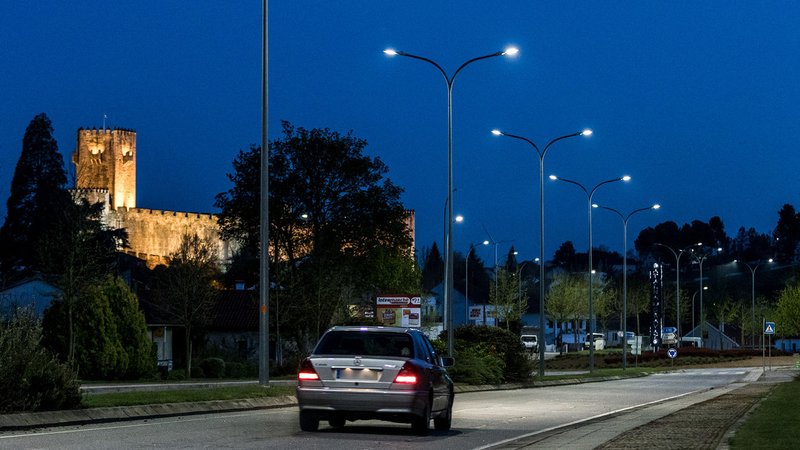
Unlike traditional street lights, which operate at a fixed brightness and switch on at fixed times, Interact connected street lights are adaptive—meaning they use real-time data to understand and respond to the changing needs of the city.

Interact traffic and weather adaptive lighting systems use sensors and external data to understand the environment and lighting requirements in real time. The lighting system responds by automatically increasing the brightness to improve visibility on wet or foggy days, reducing glare on wet roads, and dimming on clear nights to save energy."

Lighting can also adjust according to traffic flow, dimming on quiet roads then brightening when a car approaches, while busy roads require consistently bright light. By responding to real demand rather than fixed schedules, adaptive lighting improves road safety while reducing energy use, ensuring light is delivered where and when it is needed most.
sabugal-800x450.jpg


City-wide visibility and control
 

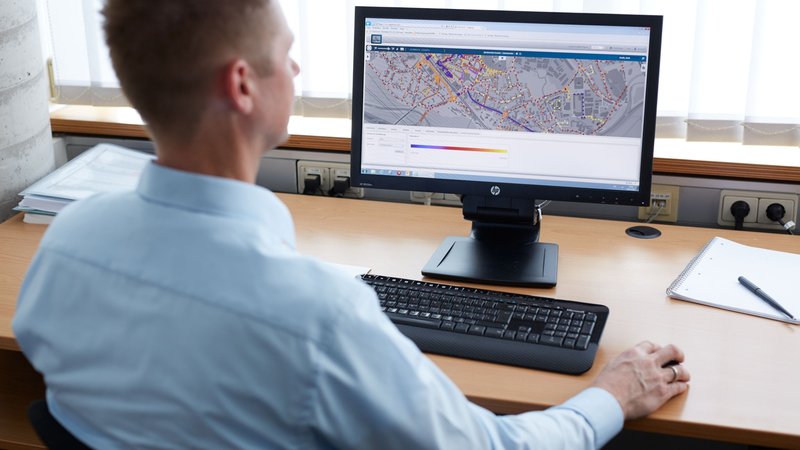
Another recently announced Interact innovation, the Central Management System (CMS), acts as a central control point for the entire city’s lighting infrastructure, allowing operators to remotely monitor, control, and manage lighting networks from a single platform.
 

Access to real‑time visibility and performance data improves maintenance efficiency, reduces energy use, and ensures consistent lighting performance across cities and road networks. CMS also acts as an enabler to future-proof cities, allowing them to add new features over time while maintaining a single management point.
 

Operators can see which lights are on or off, measure how much energy is being consumed in each area, and identify faults or outages in real time to get them repaired as quickly as possible, minimizing disruption and optimizing operations in the city.

siegburg-800x450.jpg


Always learning, always improving
 

Each connected light point generates data on usage patterns, energy consumption, traffic and pedestrian activity, and environmental conditions—and this massive collection of constantly changing data can help a city's infrastructure learn and improve over time.
 

Since the smart city is not an end status, but a dynamic platform that welcomes innovations, connected lighting systems can provide crucial infrastructure that gives city operators the possibility to continuously explore new ways to improve life in the city.
 

Solutions like Interact also directly support a city in achieving its urban sustainability targets because lighting represents a major part of municipal energy use. Lowering consumption and CO₂ emissions helps cities meet net-zero targets and energy-efficiency mandates.


The era of adaptive cities is now
 

The shift toward adaptive cities is not simply a technological upgrade—it represents a fundamental change in how urban environments are designed, managed, and experienced.

Connected lighting sits at the heart of this transformation. By turning a ubiquitous and essential service into a data-driven and data-collecting digital platform, it provides cities with a practical and scalable way to begin their journey toward greater responsiveness."

From improving energy efficiency and reducing emissions to optimizing operations through real-time decision-making and predictive maintenance, connected lighting demonstrates how infrastructure can evolve to meet the unpredictable demands of modern urban life.

About the author:

Pedro Pinto

Pedro Pinto


Global Head of Segment, Public 

About Signify


Signify (Euronext: LIGHT) is the world leader in lighting for professionals and consumers. We proudly bring to market the world’s best lighting brands, from SignifyPhilipsPhilips HueSignify InteractPhilips DynaliteColor Kinetics and many more. Our advanced products, connected systems and services unlock the extraordinary potential of light for brighter lives and a better world. In 2025, we had sales of EUR 5.8 billion, approximately 27,000 employees, and a presence in over 70 markets. We are in the Dow Jones Sustainability World Index and hold the EcoVadis Platinum rating.


News and updates from Signify can be found in the Newsroom, on LinkedIn and Instagram. Information for investors is located on the Investor Relations page.

More blogs

  • Power of light in chemistry

    April 15, 2026

    Power of light in chemistry

  • How light can support more sustainable aviation?

    February 11, 2026

    How light can support more sustainable aviation?

  • Why experience is the real innovation at home

    January 28, 2026

    Why experience is the real innovation at home